


Good morning fellow travellers, aspiring warriors, and those of you still convinced that airline food is, in fact, edible and not a long-running psychological experiment testing the limits of what humans will put in their mouths if sufficiently bored and deprived of oxygen. This week we’re headed to Asia, because... why not. We love Asia and what better reason than to celebrate the birthday of William Adams, born September 24, 1564.
William Adams didn’t set out to become the first Englishman in Japan, a confidant of a warlord, or the inspiration for James Clavell’s Shōgun. It just all rather happened. Like many a young Kentish lad with a thirst for adventure in the 16th century, he wanted to sail east, maybe get rich, and not die of scurvy en route, and as that celebrated 20th century poet and troubadour Michael Lee “Meatloaf” Aday once belted, “Two out of three ain’t bad.” Adams never got rich, but he survived the journey east, landing in Japan in 1600 as one of a handful of shipwrecked survivors from the Liefde, a Dutch trading expedition gone spectacularly pear-shaped.
Many of Adams’ fellow crewmates had the good sense and decency to perish beneath the waves. Those who made it ashore, if we are to believe James Clavell’s novelistic version of the events, received a decidedly mixed reception.* Adams somehow thrived. He met Tokugawa Ieyasu, one of the most powerful lords in Japan, then busy unifying the realm through the traditional methods of running people through with swords, careful strategic planning, and overwhelming his enemies with his tactical brilliance and ruthless cunning.**
The future Shōgun also had a talent for HR management, and reckoned the bedraggled white boy from Kent might someday be useful. Adams and fellow shipwreck survivor Jan Joosten eventually became hatamoto, which is kind of like a samurai but not quite, and yet still closer than anyone writing or reading this newsletter will ever get. Adams and Joosten were allowed to carry swords and even permitted to use them.
Imagine washing up on a beach on the Kyūshū shoreline, sunburned, half-starved, and speaking no Japanese. A decade later you’re fielding policy questions from one of history’s great strongmen whilst sporting proper samurai kit. That is impressive. Our cousin Nigel landed in Japan to teach English in 1998 and all he ever got was an obsession with anime and a restraining order from the Sanrio corporate offices.
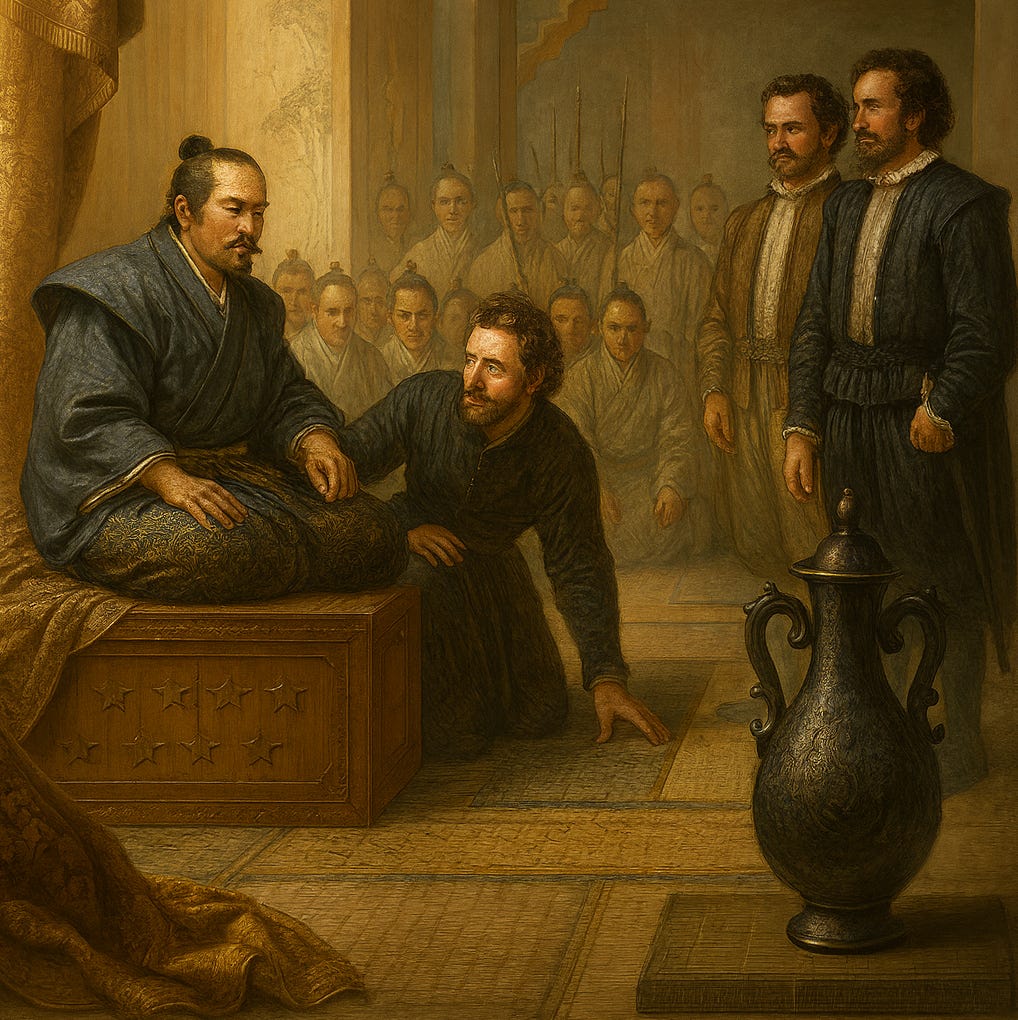
Adams eventually acquired a Japanese family, while his English-born wife and children remained... well, back in England, presumably wondering where the hell he’d got to. History is messy like that.
When eventually told he could return home, Adams chose to stay. Perhaps he’d calculated that the odds of survival were better with the Tokugawa than with whatever fresh madness awaited him on the voyage back to England. Adams died in Japan in 1620, aged 55, never having seen the shores of Blighty or his English family again. Still, for a shipwrecked lad from Kent, “Miura Anjin” did rather well for himself.
That’s all from your correspondents, who have been to Japan many times but never once were allowed to carry swords in public. More’s the pity.
*Important safety tip if we’re ever transported to medieval Japan: Skip the soup course.
**I’d love to see those Silicon Valley crypto bros slagging each other as “soy boys” to pop round to 1600 and explain to Tokugawa Ieyasu (you know, the bloke who held Japan in his armored fist) how all that tofu and soy sauce was somehow sapping his masculine energy.