


Your correspondent is checking in this week from the Swiss Alps, where the mountains are world-class and a hot chocolate costs $15. Almost worth it when that cup of cocoa is served with a view like this.
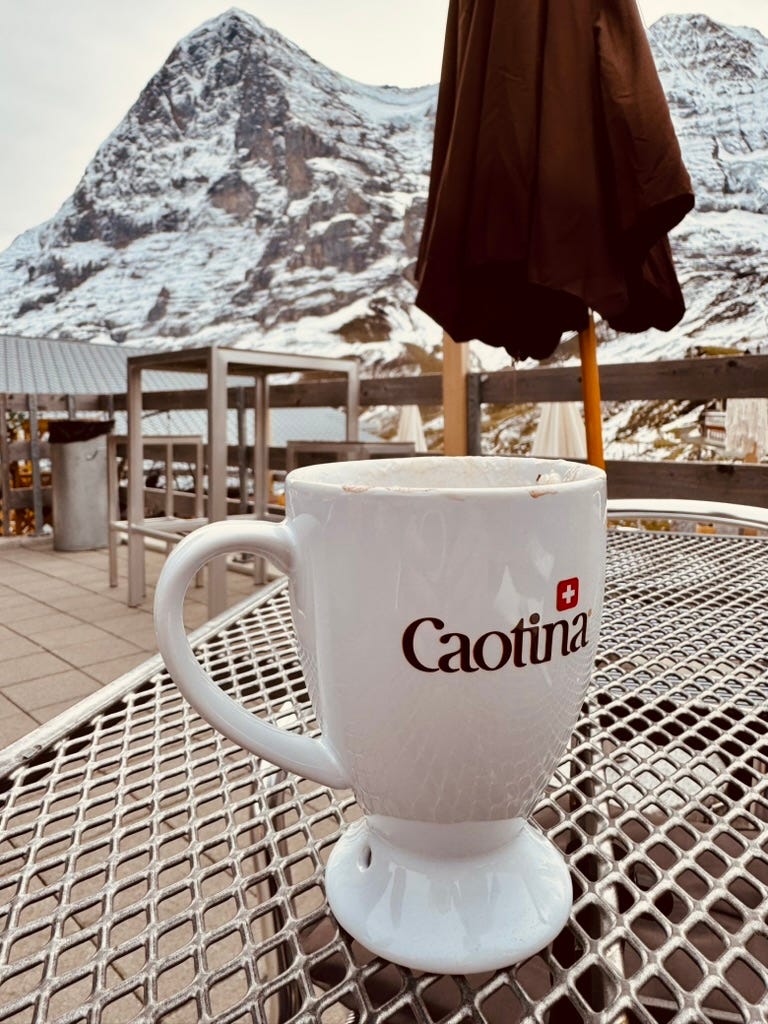
Rising above our table is one of the most imposing slabs of limestone in the history of mountaineering. The locals call it the Nordwand, a.k.a. the North Face of the Eiger, but climbing lore has another name: “Mordwand,” a macabre German pun that translates to “The Murder Wall.”[1]
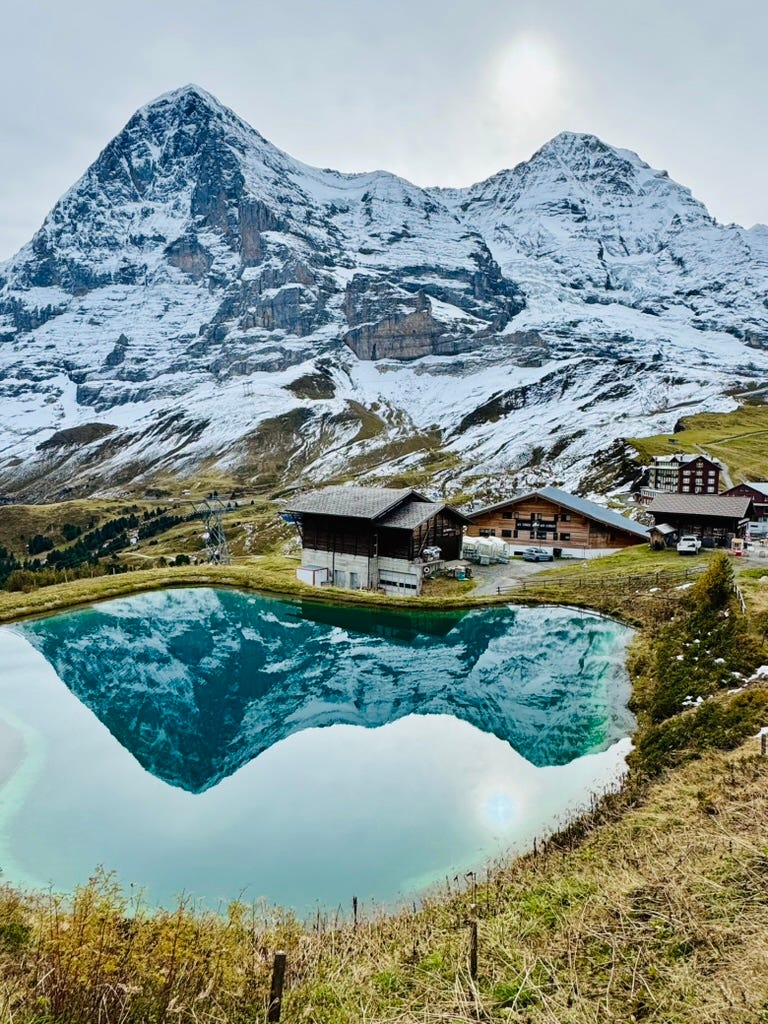
It is stillness, violence, death, and near-impossible beauty: a 13,000-foot wall of rock, ice, and snow that has claimed at least 64 lives over the past century, more than Ted Bundy, the Manson Family, Norman Bates, and Jack the Ripper combined.
Down in the valley, restaurants once trained telescopes on the Eiger for the amusement of guests. Heinrich Harrer (more on him later) wrote about the tourists in Grindelwald tucking into a fondue dinner whilst watching some poor sod dangle from his pitons 1,000 metres above.[2] It’s bread — dipped lavishly in melted cheese, of course — and circuses in the Bernese Oberland.
What drives a person to commit to an activity only marginally safer than lathering up in liquid Gruyère and picking a fight with a pack of drunken badgers?
Answers vary. Ernest Hemingway once famously declared that “There are only three sports: bullfighting, motor racing, and mountaineering; all the rest are merely games.” And then there is George Mallory’s Oxbridge classic humblebrag offered when a journalist asked the famous alpinist why he wanted to climb Mount Everest: “Because it’s there.”
But Mallory never made it back from Everest, and whilst it’s easy to imagine old Ernie bellying his way up to a Key West bar, it’s a bit harder to envision him gymnastically negotiating an 1,800-metre vertical face as said face whimsically sends down chunks of ice and stone, ranging from mere pebbles to natural projectiles the size of a Mini Cooper.
In 1934, the first recorded attempt on the North Face of the Eiger did not go too badly, all things considered. No, the three-person climbing team did not reach the top, but they all managed to get back down safely, which was more than could be said for the second attempt the following year. That climb ended tragically when Karl Mehringer and Max Sedlmeyer froze to death at 3,300 metres at a spot that many still refer to as “Death Bivouac.”[3]
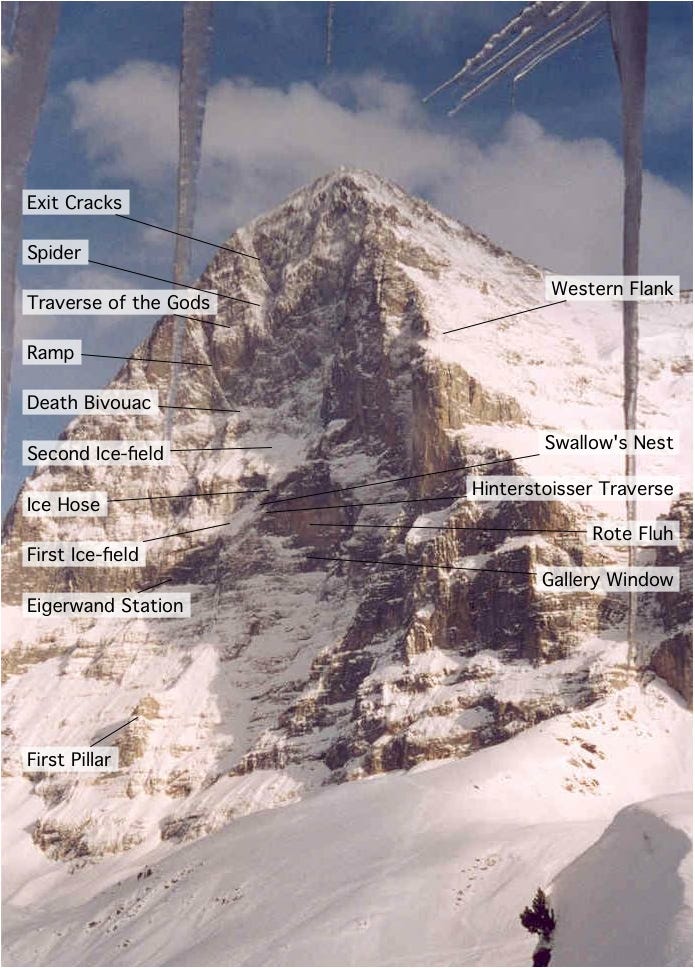
In 1936, four more climbers died, including Andreas Hinterstoisser, who did accomplish a difficult traverse of an icy slab of rock, fixing a rope that finally unlocked the crux of the Eiger’s north face. Unfortunately, Hinterstoisser’s group took the rope with them after they completed the traverse. Forced to retreat but now without a line fixed in place, the group was unable to recross the slab, and instead attempting to abseil off the face. Hinterstoisser’s name remains fixed to his traverse, but he died during the retreat, as did all three of his companions.
Success finally came in 1938 when a party of four, including Heinrich Harrer, completed the route in three days. Although it was hailed as one of the greatest feats of alpine climbing at the time, the achievement is now tarnished in mountaineering history by their association with the Nazi Party and the way the climb was exploited in German wartime propaganda.[4] Nevertheless, Harrer’s 1958 book The White Spider, named for the arachnid-shaped ice field that acts as a funnel and launching pad for the North Face’s notorious cannonade of rock and snow, remains one of the classics of mountaineering literature.[5]
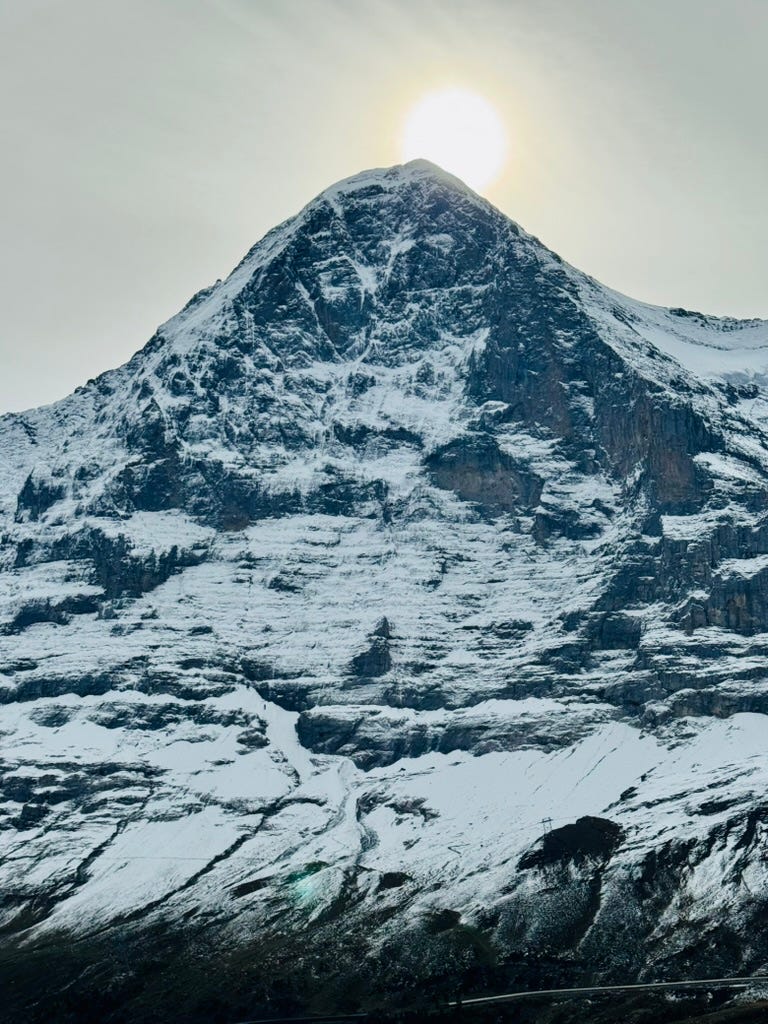
The Swiss Alpine Club does not maintain an official register, but the number of people who have successfully climbed the North Face of the Eiger since 1938 is reckoned to be in the thousands. In 1992, Catherine Destivelle became the first woman to solo the north face in winter, spending seventeen hours alone in the February cold. Local hero Ueli Steck speed-climbed the North Face in under three hours in 2008, the same year that American climber Dean Potter free soloed Deep Blue Sea, considered one of the most difficult routes on the Eiger, and then parachuted back down again. Both survived their appointment with the North Face, but neither is alive today. Potter died in a wingsuit accident in Yosemite; Steck on Nuptse in the Himalayas. Mountains are unsentimental. There aren’t leaderboards. They keep score in bodies.
Perhaps those who climb mountains do so filled with the same instinct which keeps travellers on the road, hikers on the path, and sailors pushing for the next horizon. A lingering strand of restless DNA coded by distant ancestors who looked around their warm cave and thought:
This can’t be all there is. I wonder what’s outside, beyond the firelight, and on the other side of the darkness.
Millennia later, the descendants of these wandering souls camp in lovely Swiss valleys and Yosemite meadows, look up at a face of rock and think, “Challenge... accepted.”
And then there’s the aesthetic power of mountain landscapes, which Switzerland has monetised with the same ruthless efficiency they bring to timekeeping and banking for despots.[6] The thrill of the Alps need not be reserved for intrepid climbers heading ever upwards. Many who journey here would agree that the slopes are often best enjoyed going in the other direction, aided with just a soupçon of gravity, descending gracefully on skis, snowboards, and toboggans. Or, in the case of your correspondent on this past visit, wedged into an inflated inner tube sliding down a groomed snow slope at 3,400 metres (11,330 ft) outside the Jungfraujoch, Europe’s highest train station.
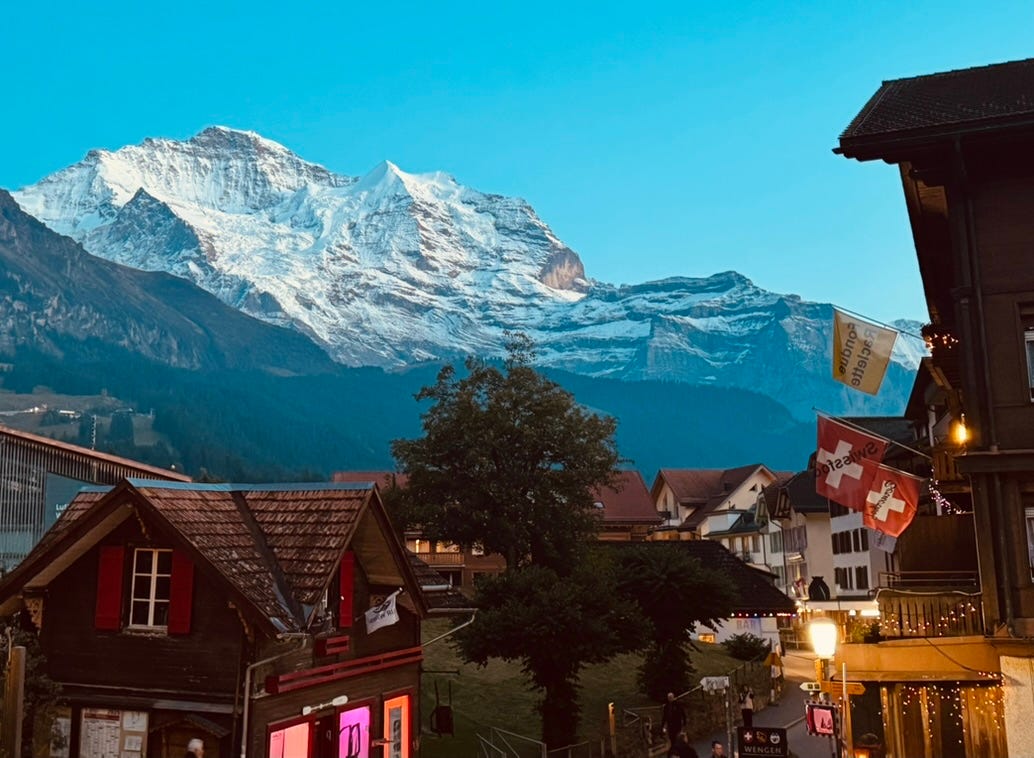
Staying in Interlaken, Wengen, Grindelwald, Kleine Scheidegg, or any of the quaint and picturesque towns of the region, one can be forgiven for overlooking the darker history of the mountains which loom overhead, beckoning the unwary or unafraid.
For now, though, that is all we have to write from the sunnier side of a Swiss Alp, where the views are spectacular, the cheese comes weaponised in pots, and the cocoa is served with a slice of alpine history and a call from your bank’s credit card fraud department:
“Is that really what you paid for one cup of cocoa?”
Footnotes
[1] No language does morbid honesty quite like German.
[2] In The White Spider, Harrer writes about the gawkers and vicarious thrill-seekers lining up at the telescopes to watch the climb. It’s also a plot point in both the book and film versions of The Eiger Sanction, written by the mononymic thriller writer Trevanian.
[3] Although the name has been changed on tourist maps to “Karl Max Bivouac,” reflecting the rare occasion when the Swiss have prioritized euphemism over accuracy.
[4] You may also know him as “Brad Pitt” in the film version of Seven Years in Tibet, based on the German alpinist’s travels through the Himalayas in the late 1940s and early 1950s.
[5] Your correspondent’s favourite contribution to Eiger lore is an early article by Into Thin Air author Jon Krakauer recalling an attempt he made in tandem with a then–up-and-coming Mark Twight (identified as “Marc” in the article). Krakauer and especially Twight were important influences for your correspondent as a young person, encouraging his own occasional mad attempts to shimmy up the sides of cliffs, frozen waterfalls, and mountains. While since somewhat reformed, we still highly recommends Mark Twight’s book of essays Kiss or Kill and his current Substack, Equipe Solitaire.
[6] Travelling in the Alps, one can’t help but wonder if the Swiss enthusiasm for extracting money from tourists is a lingering hangover from Calvinism, a theological belief that Heaven maintains a cover charge to keep out the riffraff. Also, the French.