


Good morning, intrepid cartographers, distance-defying dilettantes, and anyone currently trapped in a queue that promises to move “soon” but seems to obey an entirely different set of physical laws.
Listening to a podcast this morning, we were reminded about this quote from the English astronomer Fred Hoyle:
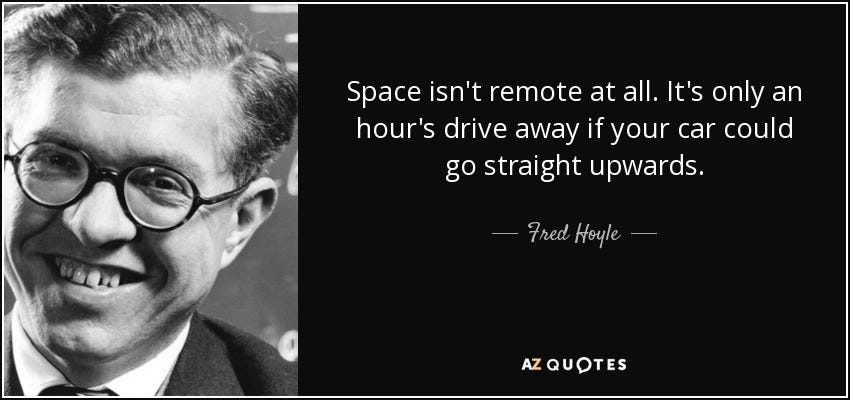
The timing was perfect coming on the heels of a message received here at the BTOC offices. After a recent edition of Compass Dispatches, a reader from Nebraska had objected to this insinuation that their home state might be so boring as to defy the laws of physics:
Your correspondent has motored from coast to coast across the United States three times, and each time it felt as though 75.4% of the journey was spent crossing Nebraska—a state so relentlessly horizontal it appears designed to test one’s commitment to the very concept of westward travel and our belief in a functioning relationship between space and time.
We stand by our assessment. But in the context of Dr Hoyle’s famous quotation, we got to wondering: In what other ways does travel destabilise our assumptions about that all-important relationship between where we are, where we are going, and how long it will take to get there? Are we all just Heisenberg’s particles? Condemned to know where we are, or how fast we are moving, but never both.*
The Chinese have long used a measurement for distance called the li 里 (lǐ). It’s a traditional term but also appears in modern Chinese words for kilometer 公里 (gōnglǐ) and mile 英里 (yīnglǐ). The latter translates as “English mile,” though given America’s steadfast refusal to embrace the metric system whilst simultaneously lecturing the world about progress, “Stubbornly Anachronistic Mile” might be more accurate these days.
The thing is, the original Chinese li 里 (lǐ) did not really have a fixed measure. It is generally reckoned in most Western accounts as about one third of an English mile, but the brilliance of the li 里 (lǐ) is that it is a measure of distance that also factors in a wonderful array of other variables like time, terrain, elevation, and a variable familiar to trekkers and hikers the world over: “the suck factor.”
That is not an X-Factor spin-off hosted by the Hawk Tuah girl (Semi-NSFW), but rather a crucial element when answering questions of time/distance such as: “How much further is it to the top?” To which the reply might be: “The trail ahead is short, but the suck factor is high. Many loose rocks. Steep incline. Homicidal carnivorous mutated goats await at every turn.”

And then there is the “Cuban mile” from the Fast and the Furious, a film series famous for its rigorous adherence to the laws of mathematics and physics.
The Scots may not have raised mutant goats, but they did have their own “Scots mile,” which was longer than the English version (because…it’s Scottish, aye?) and best measured by whether you were crossing farmland, in a Highland bog, or chasing the last bus doon Sauchiehall Street after six pints.
We’re told that the term “mile” comes from the Roman legions, who marched many mille passus, which for the Latin impaired, translates to “a thousand paces.” But whose paces, exactly? Roman legionaries were not known for towering height, and after a full day’s march in heavy armor, a Roman “pace” might have been rather shorter than advertised.
The Persians developed the farsakh, which like the Chinese li 里 (lǐ) was refreshingly honest about the relationship between distance and reality. A farsakh was roughly the distance a person could walk in an hour, but it expanded and contracted based on terrain, weather, and the honesty of your guide.**
Modern travel can be like this, too. Your correspondent flew out of Amsterdam this past weekend. No business class on this journey; it was strictly EasyJet all the way. We often have good luck on EasyJet, but this flight was full and every soul on board seemed to be either a football lad, a hungover hen party refugee, or a child under the age of six.
Needless to say, the fasten seat belt light had not even had time to cool in its casing before the lavatories were a shambles. Against all common sense, we used one midflight and it looked like Jackson Pollock had been in there after a particularly nasty dinner of spoiled mussels. There was also a lot of screaming, crying, and general mayhem. Some of it even came from the toddlers on board.
The flight, according to our booking and the inflight video screen, was only 1,300 kilometres and 94 minutes. It felt much, much longer.
So, when planning a trip, it is wise to look to the wisdom of Ancient China and consider the “Li Equation of Travel Misery”:

\text{Travel Misery Index} = \frac{\text{Distance} \times \text{Suck Factor}}{\text{Desirability of Destination}}Travel Misery Index=Desirability of DestinationDistance×Suck Factor
Twenty miles crammed on a bus feels trivial if it ends on a beach in Goa, intolerable if it ends at a trading estate in Luton. One kilometre on foot is bliss along the Danube at sunset, but unendurable if it means skirting the shoulder of a Los Angeles arterial road while dodging bottles of suspicious liquid, abandoned car parts, and what may or may not have been the final chapter in the story: “Possum Met a Truck.”
That’s all from Row 28 of an EasyJet bound for destinations unknown but deeply desired, if only to finally disembark this airborne circus and plant our feet on solid ground once more.
—The By Their Own Compass Team
* Nowhere is this truer than when attempting to travel by city-to-city rail in the United States.
**The farsakh is, of course, not to be confused with the parsec, a unit of stellar distance famously mangled by Han Solo in the first Star Wars when he boasted about making the “Kessel Run” in less than 12 parsecs. Even a long time ago, in a galaxy far, far away, pilots were overconfident on their ability to deliver on time arrivals.